AI Data Fabric
Unify Exposure Managements for Resilient Security Operations and Governance.
The Challenge

What is a Data Fabric?
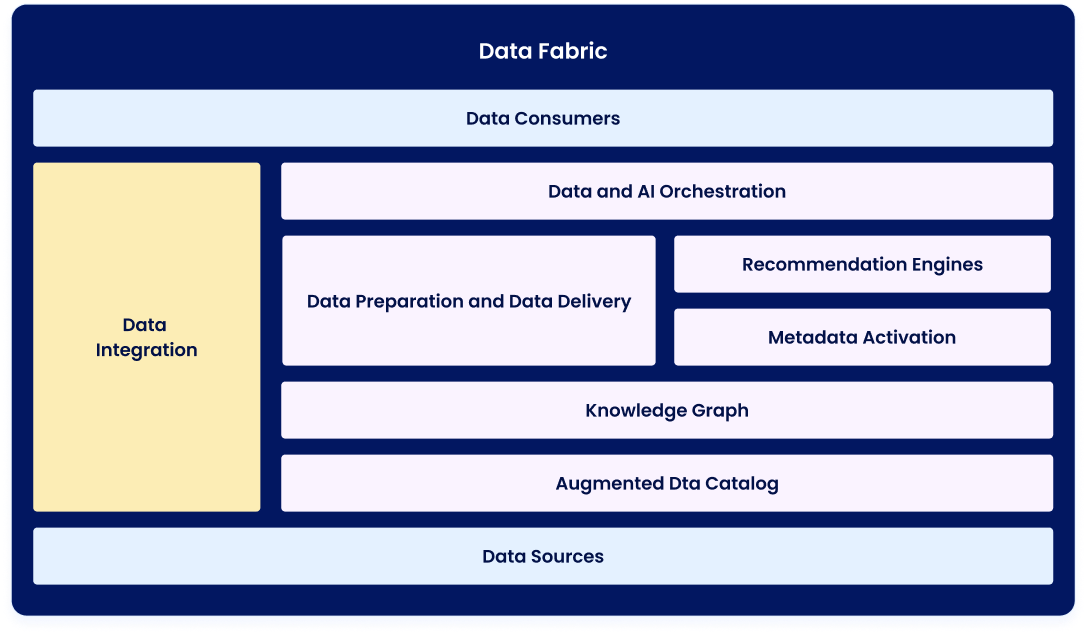
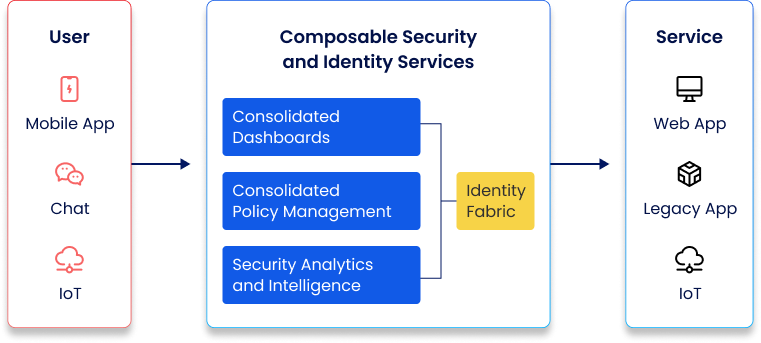
In summary, a data fabric is an architectural approach and technology layer that integrates data across diverse platforms, locations, and types. It enables consistent data management, seamless access, governance, and enhanced insights, regardless of data location (on-premises, cloud, or hybrid environments).
This concept is the basis for Tonic’s AI Data Fabric, applied to Exposure Management.
What Role Does AI Play in Data Fabrics?
Data Fabric vs. Data Mesh (or CSMA)
There’s some confusion around this that needs clarification.
Data Mesh vs. Data Fabric
Cybersecurity Mesh Architecture (CSMA) vs. Data Fabric:

integration and Operational Security.

Leveraging an AI Data Fabric for Exposure Management

The Tonic Data Fabric:
Security that Makes Sense
For organizations ready to elevate their security posture, the roadmap is clear.

Tonic's AI Data Fabric allows users to make their security data:
01
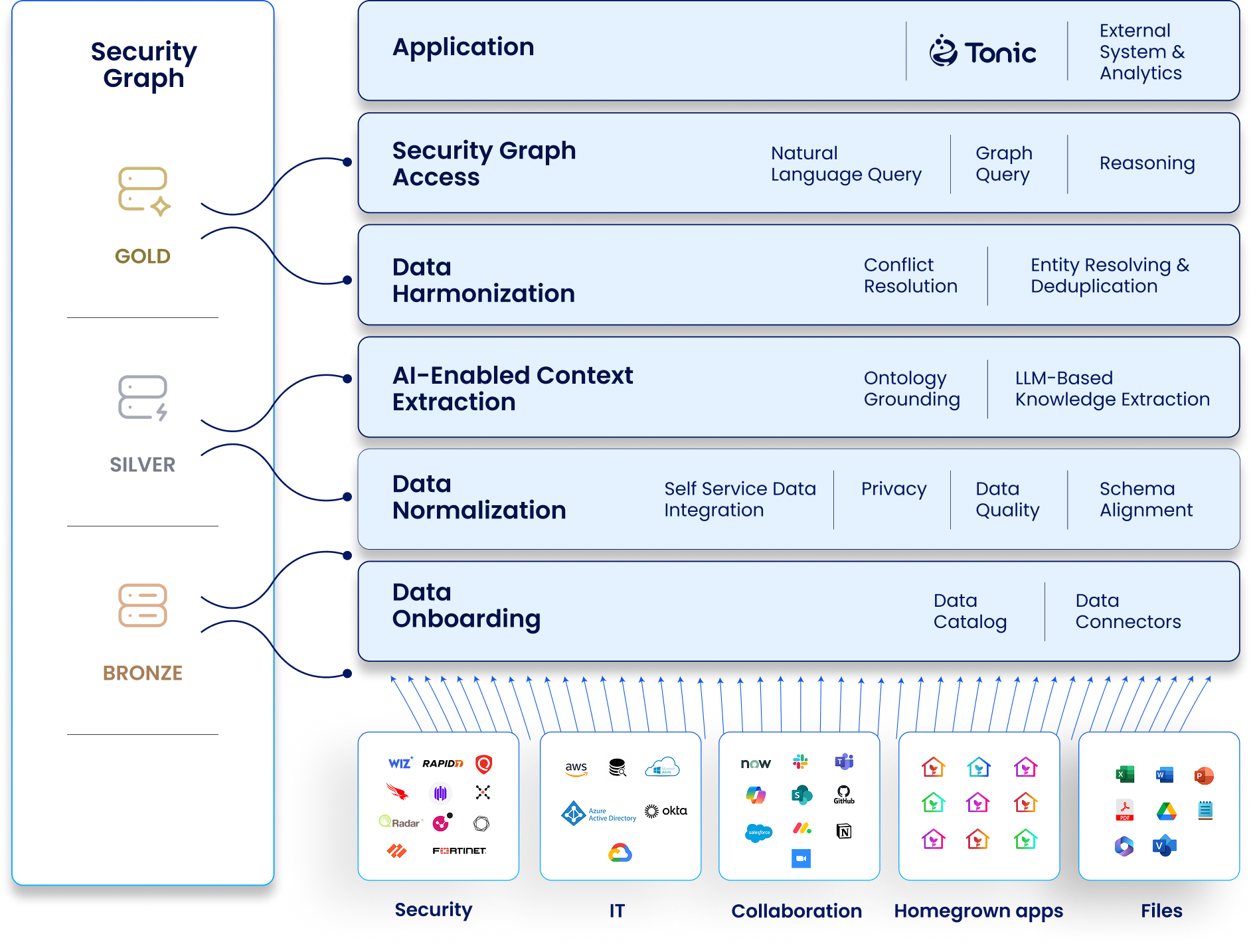
Tonic’s multi-layered Data Fabric begins with data onboarding - where we gather data from security tools, collaboration systems, IT tools, and homegrown applications - and store it in a raw data “Bronze” repository.
02
Then it normalizes the data, converting and standardizing data, improving data integrity, and removing sensitive data to ensure privacy by design. Normalization ensures that data can be accurately compared and analyzed. Normalized data is stored in the “Silver” repository.
03
In the next steps, our AI does most of the heavy lifting. The Data Fabric extracts context and insights from structured and unstructured data (such as emails, documents and chats) and uses LLMs and other models to identify entities and their relationships. The context extracted includes business, organizational, geographical, operational, temporal, and adversarial.

The data is harmonized, resolving conflicts between data sources,
considering source reliability, data recency, and consensus among sources.
The harmonization process includes:

Correlation
The process of identifying and matching records that represent the same entity but are described differently across disparate data sources. Variations include format, spelling, or structure. Correlation is foundational for both deduplication and aggregation, as it ensures that data referring to the same entities is accurately matched and integrated, leading to more consistent, comprehensive, and high-quality datasets.

Deduplication
The process of identifying and removing duplicate records from a dataset. When data comes from multiple sources, duplicates are common, and deduplication ensures that each unique piece of information is represented only once.

Conflict Resolution
Data from different sources can often be inconsistent or contradictory. The Tonic AI Data Fabric resolves these conflicts by determining the most reliable or representative value - also known as the “winning” value - using techniques such as consensus analysis, maximum/minimum selection, coalescing, and other domain-specific methods. This ensures data integrity, consistency, and trustworthiness across the unified dataset.

Aggregation
Grouping of several entities to perform analysis as a whole. This is done by combining data from multiple sources into a single, coherent dataset. It is often used to create reports, dashboards, and summary stats from large and diverse sets of data.
04
Ultimately, the harmonized data is organized into well-defined entities and their interrelationships, forming a Security Graph. This graph acts as the “Gold” repository - a single, authoritative source of truth that unifies, contextualizes, and preserves critical information across the enterprise. It enables consistent, graph-driven reasoning and supports advanced security analytics, decision-making, and automation.
05
Finally, the application access layer allows end users to query the graph using both structured queries and natural language.
About Tonic Security
Tonic accelerates prioritization and remediation of vulnerabilities and threats, with a Context-Driven Unified Exposure Management platform. Powered by Agentic AI and a security Data Fabric, Tonic extracts meaningful and actionable context from unstructured organizational knowledge and threat intelligence, empowering security teams with superior visibility, dramatic reduction in false positives, and a sharp focus on findings that matter. Leading organizations, including Fortune 500 companies, rely on Tonic to slash remediation time and reduce risk to key business processes.